



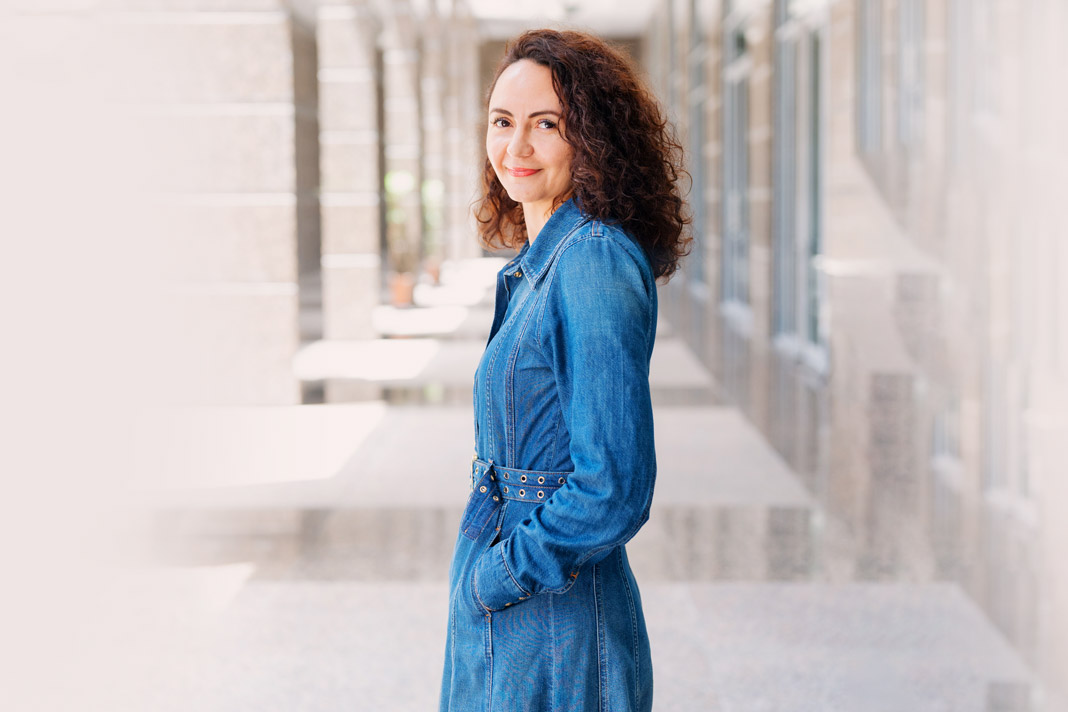
Curator and artist Yasmin Sharabi has spent her life between cultures. As she prepares for a new chapter in the United States, she opens up to Kristian Harrison about turning towards psychotherapy, inherited stories and healing through art.
Born in Greece to a Palestinian father and an American mother, Ms. Sharabi has never belonged to a single place. That sense of in-between has shaped a career in which she has guided institutions, collections and audiences, yet it is now pushing her towards a quieter but more personal path.
“I have always known my life would involve art,” she says, “but recently I started to realise that the way I was working with art needed to change.”
Between histories and homelands
Art entered Ms. Sharabi’s life early. After moving to Bahrain as a child she attended St Christopher’s School, where a particularly committed art teacher encouraged her talent and made studio work feel like a serious pursuit rather than an extracurricular diversion. University studies followed in Montreal, where she read studio art and art history, then a Master’s in Art Business at Sotheby’s Institute in London.
Behind this formal training sat a more complex education at home. Her mother grew up on a farm in South Dakota, her father is Palestinian and was born in 1938. His memories span British rule, conflict and displacement, and he has long been, as she describes him, “like a history book”. Now in his late 80s, his detailed recollections remain a powerful presence in the family.
Those layered histories: Midwestern rural life, Mediterranean childhood, Bahraini adolescence, Palestinian exile; have given Ms. Sharabi a particular sensitivity to questions of belonging, continuity and loss. They also underpin the themes she is increasingly drawn to in her own work.
Building institutions, carrying stories
Professionally, Ms. Sharabi’s path has traversed many of the Gulf’s key art developments of the past two decades. After London she joined one of the early commercial galleries in Dubai’s DIFC, then returned to Bahrain to work at Bahrain Financial Harbour, initially in public relations before taking responsibility for its gallery and exhibitions.
Most recently she served as founding director of the RAK Art Foundation in Riffa, where she helped shape a significant regional collection and played a central curatorial role in a new MENA museum project in Saar. There she developed displays around the idea of continuity, focusing on how artists negotiate the tension between preserving heritage and embracing the future.
Alongside this institutional work she has contributed to international conversations, including speaking at Harvard’s Graduate School of Design about the reuse of traditional architecture and its relationship to sustainability. Yet however gratifying these platforms have been, they also reinforced a feeling that much of her energy was devoted to articulating other people’s stories rather than fully exploring her own.
 From institutions to inner work
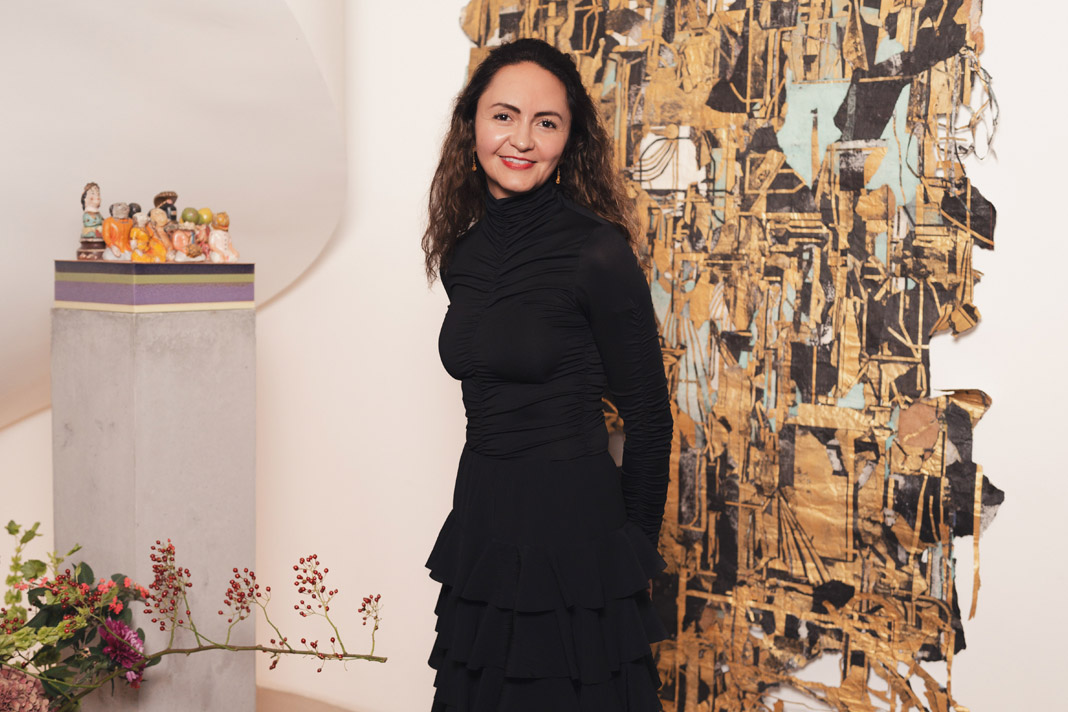
A recent qualification in psychotherapy and hypnotherapy has sharpened that realisation. What began as a personal interest has become a new lens through which Ms. Sharabi views both art and life.
“The course made me think about my work differently,” she says. “Trauma does not simply vanish with one generation. It can be inherited, held in the body and passed on in the way you move through the world.”
Her father’s experiences, the wider Palestinian story and the ongoing devastation in Gaza all feed into this reflection. She is clear that art can never be separated from politics, yet she is equally clear that overt slogans are not what she wants to produce.
“Politics is everywhere, and art is political,” she says. “But if you want to create change you have to reach people at a human level first.”
The work she imagines making in the coming years will therefore be intimate rather than declarative: pieces that explore her relationship with her father, the transmission of fear and resilience, and the ways in which family histories leave marks that may only be recognised decades later.
Choosing a different future
To give that work space, Ms. Sharabi has decided to step away from the security of her current position and relocate to the United States with her Brazilian husband and their cats. She is candid about the risks. There is no substantial nest egg, her family has known periods of financial uncertainty and the logistics of an international move are daunting.
“What stopped me before was always fear of not having money,” she says. “If you live by that fear, you never make the change.”
Rather than chasing an expensive flat in New York, she imagines settling in a smaller town with more physical and mental space, visiting major cities when needed but not allowing them to dictate her life. She has a sister and niece already in New York, another niece studies in Montreal and her parents still return regularly to Bahrain, where her other sister, niece and nephew also reside; ensuring the network of relationships across continents will remain. What will change, she hopes, is the balance between institutional obligations and persoal exploration.
In practical terms the immediate goals are modest: to arrive, settle, take time away from formal employment and re-establish a regular studio practice. In the longer term she would like to exhibit again, perhaps drawing together themes of migration, climate, inheritance and healing that have surfaced in both her curatorial and therapeutic work.
For now, though, the most significant act is the decision itself. After years of helping to build spaces for other people’s art, Ms. Sharabi is choosing to trust that the stories she carries; of Palestine and Bahrain, of Athens and the American plains, can find their fullest expression when she grants them the time and attention they demand.
Politics is everywhere, and art is political….but if you want to create change you have to reach people at a human level first.”
– Yasmin Sharabi